
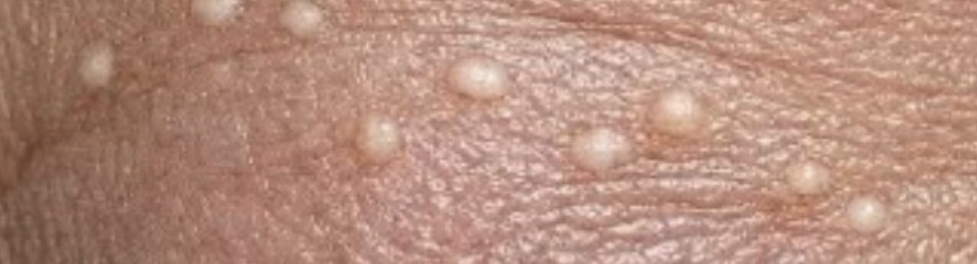
Tiny white bumps appearing on the eyelids can be surprisingly noticeable, especially when they develop in a cluster. They may look like small whiteheads, but many eyelid bumps are not acne at all. One common explanation is milia, small, harmless cysts filled with keratin, a protein naturally found in the outer layers of the skin.
The image shown here has the appearance of multiple small, pearly-white bumps along the eyelid, which can be consistent with milia. However, an image alone cannot establish a diagnosis. Several different conditions can produce small bumps around the eyes, so persistent or changing lesions should be assessed by a dermatologist or eye-care professional.
What Are Milia?
Milia are tiny cysts that form just beneath the surface of the skin. They usually appear as firm, white or yellowish, dome-shaped bumps and are often only about 1–2 millimeters in size. They commonly occur on the face, particularly around the eyelids, cheeks, forehead, and nose.
Unlike a typical pimple, a milium does not usually contain the mixture of oil and inflammatory material associated with acne. Instead, it contains keratin. When several are present, the plural term is milia.
Milia can affect babies, children, and adults. In newborns, they are particularly common and generally disappear naturally. In older children and adults, they may remain for months or sometimes longer.
Because the eyelid skin is thin and delicate, even very small milia can be highly visible.
Why Do These White Bumps Develop?
There isn’t always one obvious reason why someone develops milia. In many cases, they simply arise without an identifiable trigger.
Primary milia develop independently, while secondary milia can develop as the skin heals after injury or inflammation. They have been associated with conditions or procedures that damage or disrupt the surface of the skin, including burns, blistering disorders, and certain dermatological procedures. Some topical medications have also been reported in association with secondary milia.
This is important because people sometimes assume that white bumps automatically mean their skin is dirty, their pores are clogged, or they have poor hygiene. That is not necessarily the case.
Milia are not simply a sign that someone has failed to cleanse their skin properly.
Milia Versus Whiteheads
Milia and whiteheads can look similar, but they are different types of lesions.
A whitehead is an acne-related closed comedone. It develops when material accumulates within a hair follicle. Milia, on the other hand, are tiny keratin-filled cysts located just beneath the skin surface.
Milia are typically:
- Small and firm
- Pearly white or cream-colored
- Dome-shaped
- Usually not painful
- Not surrounded by significant redness
- Common around the eyelids and cheeks
Whiteheads may be more closely associated with other acne lesions, oily skin, or clogged follicles.
Because the eyelids are a sensitive area, attempting to treat what looks like a whitehead as though it were acne can cause unnecessary irritation.
Are Milia Dangerous?
In most cases, milia are benign and do not pose a serious health threat. They generally do not hurt, although their appearance can be frustrating.
DermNet notes that milia often do not require treatment and may disappear spontaneously over time. Some can persist for months or longer.
The main concern is therefore usually cosmetic rather than medical.
However, not every white bump near the eye is necessarily a milium. Other eyelid lesions and skin conditions can resemble milia, including syringomas, other cysts, xanthelasma, and certain inflammatory or infectious conditions.
That is why a new, unusual, persistent, or changing lesion deserves professional evaluation rather than an assumption based solely on its appearance.
Should You Pop or Squeeze Them?
One of the most important things to avoid is trying to squeeze, scratch, or puncture eyelid bumps yourself.
Because milia are firm cysts rather than ordinary pimples, squeezing them may not work. More importantly, manipulating the delicate skin around the eye can cause irritation, bleeding, infection, or scarring.
Professional removal may involve opening the surface of the milium with a sterile instrument and carefully removing its contents. Dermatology professionals can also use other treatments in appropriate cases.
The area around the eyes deserves particular caution. A DIY extraction tool, needle, pin, or sharp object can cause an injury to the eyelid or, if used carelessly, the eye itself.
How Are Milia Treated?
Treatment isn’t always necessary. If the bumps are harmless milia and do not bother the person, simply leaving them alone may be appropriate.
When treatment is desired for cosmetic reasons, a dermatologist can remove individual lesions using a sterile technique. Other options may sometimes be considered depending on how extensive the milia are. DermNet lists procedures such as de-roofing, curettage, diathermy, cryotherapy, chemical peels, dermabrasion, and laser treatment among approaches that may be used in selected situations.
For widespread milia, topical retinoids may sometimes be helpful, although products containing retinoids should not simply be applied close to the eyes without appropriate professional guidance.
The best treatment depends on the person’s age, skin type, location of the lesions, number of bumps, and whether the diagnosis is actually milia.
What About Skincare?
Gentle skincare is generally the safest approach when small bumps appear around the eyes.
A basic routine can include a mild cleanser, appropriate moisturizer, and sun protection. Avoid aggressive scrubbing or repeatedly applying strong exfoliating products to the eyelids.
The skin around the eyes is thinner and more sensitive than many other areas of the face. Products designed for stronger facial exfoliation may be irritating when used too close to the eye.
It is also useful to introduce new skincare products cautiously. If bumps began after a cosmetic product, medication, procedure, or significant skin irritation, mentioning that history to a dermatologist can help determine whether the lesions could represent secondary milia.
Can Milia Be Prevented?
There is no guaranteed way to prevent every case of milia.
Because primary milia can appear without an obvious cause, even someone with a consistent skincare routine may develop them. However, minimizing unnecessary skin trauma is sensible. DermNet specifically recommends reducing further trauma where possible because injury can contribute to secondary milia.
This means avoiding unnecessary picking, scratching, aggressive exfoliation, and unprofessional extraction procedures.
Good general skin care and sun protection can also help maintain the health of the skin, although these measures should not be presented as a guaranteed way to prevent milia.
When Should You See a Doctor?
A few stable, tiny white bumps without pain or other symptoms are often not an emergency. Nevertheless, professional evaluation is worthwhile if you are unsure what the bumps are.
Seek medical advice if the bumps:
- Rapidly increase in number or size
- Become painful or significantly swollen
- Develop redness, warmth, or discharge
- Bleed or crust
- Change noticeably in appearance
- Affect vision
- Occur with significant eye irritation
- Persist and you are uncertain about the diagnosis
- Keep returning despite treatment
A dermatologist can often recognize milia from their characteristic appearance. In unusual cases, additional examination or testing may be necessary.
Any lesion that is progressively enlarging, bleeding, or changing deserves particular attention because not every eyelid lesion is harmless.
Why Do They Sometimes Keep Coming Back?
Milia can recur because treating an existing cyst does not necessarily prevent another one from developing elsewhere.
Some people experience only one or two isolated bumps, while others develop multiple lesions. There are also specific forms of milia, including milia associated with skin injury and milia en plaque, in which numerous milia develop within an inflamed plaque.
For someone who repeatedly develops many lesions, a dermatologist can investigate the pattern and determine whether there is an underlying skin condition, previous injury, medication association, or another explanation.
The Bottom Line
The tiny white bumps shown in the image look similar to the typical appearance of milia, which are small keratin-filled cysts frequently found around the eyelids. They are generally harmless and may disappear on their own, although some persist and can be removed professionally for cosmetic reasons.
The most important message is not to treat them like ordinary pimples. Don’t squeeze, pick, or puncture bumps on your eyelids at home. The skin surrounding the eyes is delicate, and unnecessary manipulation can cause injury or infection.
If the bumps are persistent, spreading, changing, or accompanied by pain, inflammation, discharge, or vision changes, professional evaluation is the safest approach. A dermatologist or qualified eye-care professional can determine whether the bumps are actually milia or another type of eyelid lesion and recommend an appropriate treatment.
In many cases, these tiny white bumps are more of a cosmetic nuisance than a serious health problem. Understanding what they may be—and knowing when to leave them alone and when to seek professional care—can prevent unnecessary irritation and help protect the delicate skin around the eyes.