
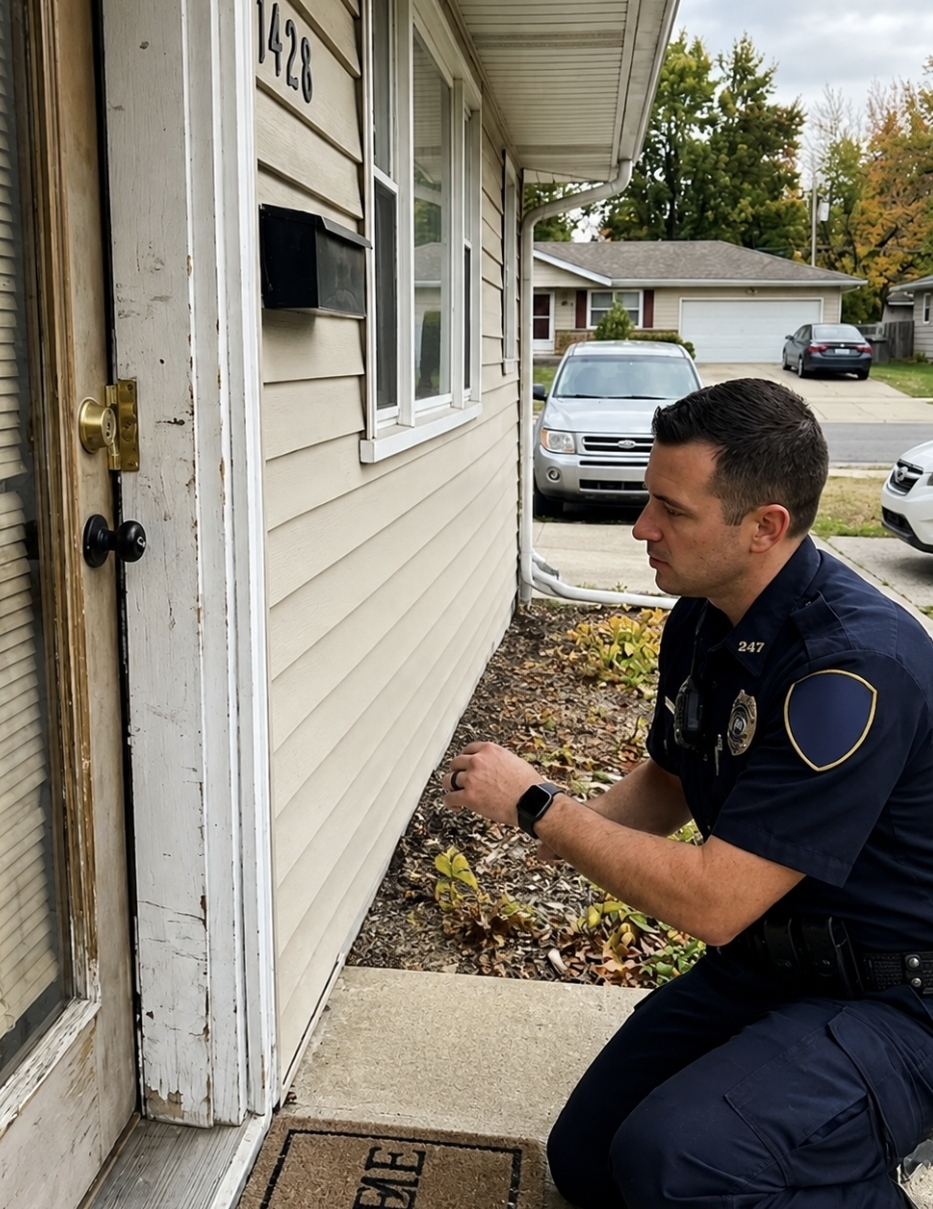
The key turned on the second try, and the seven-year-old boy did not move until I placed my hand flat against the front door and told him I would enter first.
His fingers caught the edge of my sleeve.
“You promised,” he whispered.
Image
“I remember,” I said. “You will stay where I can see you, and nobody is going to make you pretend everything is fine.”
Only then did he let go.
The house looked ordinary at first: a narrow living room, shoes beside the couch, unopened mail on a small table, and a paper grocery bag sagging on the kitchen counter.
Nothing had been overturned, and no one called out from another room.
But the boy—Owen, according to the name stitched inside his school jacket—did not relax once we were inside.
He closed the front door without letting it latch, then stood with his backpack pressed against his chest as if he might need to run again.
“Where should I look?” I asked.
He pointed toward the hallway.
The first door was a bathroom, the second held a washing machine and dryer, and the third was narrower than the others, painted the same pale color as the wall.
A metal slide bolt had been fastened to the outside of it.
The screws were newer than the door, and the wood beneath the bolt had been rubbed dark from repeated use.
Owen stopped several feet away.
“That’s the quiet room,” he said.
I looked at the bolt again.
“Who calls it that?”
“My mom. Michael calls it the reset room.”
Michael, I would learn, was his mother’s boyfriend.
I slid the bolt open and pulled the door toward me.
The space behind it had once been a pantry or utility closet, but the shelves had been removed.
A thin camping mat lay on the floor beneath a folded blanket, and a plastic cup sat beside a gallon jug of water.
There were worksheets stacked against the wall, a few broken crayons, and pencil lines drawn at the height of a child sitting with his knees pulled up.
There was no window.
There was no inside handle.
A shallow dent marked the lower half of the door, and the paint around it had cracked into a pale web.
I kept my voice steady.
“How long do you stay in here?”
Owen looked toward the front of the house before answering.
“Until I’m normal again.”
I crouched beside him, leaving enough space that he did not feel cornered.
“What does that mean?”
“It means until I stop asking to come out.”
I asked whether he slept in another bedroom.
He shook his head.
The room across the hallway, the one with a regular bed and a small dresser, belonged to Michael’s teenage son when he visited on weekends.
Owen’s clothes were kept in two plastic bins beside the washing machine.
The narrow room was not somewhere he was sent for a few minutes after misbehaving.
It was where he slept whenever Michael was home.
I reached for my shoulder radio and requested a supervisor and a child-safety responder, keeping my words plain enough that Owen would not hear panic in them.
His eyes followed my hand.
“Am I in trouble?” he asked.
“No.”
“Is Mom?”
“I don’t know yet. Right now, my job is to make sure you are safe and to understand what happened.”
He nodded, but the answer did not comfort him.
He had already learned that adults could use calm voices while deciding something frightening.
I asked whether he wanted to wait on the porch or remain inside with me.
He chose the porch because, he said, he could see both ends of the street from there.
We had barely stepped outside when a dark SUV turned the corner too fast and stopped crooked beside the leaning mailbox.
A woman in medical scrubs climbed out before the engine had fully gone quiet.
Her name was Natalie, and the first thing she did was look at the open front door.
The second thing she did was grab Owen by the wrist.
I placed my hand between them without touching either one.
“He stays beside me for now,” I said.
Natalie released him immediately, but her expression hardened.
“He ran away from school?” she asked. “I told them he has behavior problems.”
“He did not run away,” I said. “He asked me to walk home with him.”
Owen had moved behind my right shoulder, and I could feel the side of his backpack brushing my arm each time he breathed.
Natalie looked past me toward the hallway.
“You opened that room.”
It was not a question.
I asked her to explain why a sleeping area used by a child had a bolt on the outside and no handle on the inside.
She crossed her arms and said it was a calming space, that Owen became destructive when he was overtired, and that the arrangement prevented him from wandering through the house at night.
“He likes small spaces,” she added. “He asks to go in there sometimes.”
Owen’s fingers tightened around one of his backpack straps.
I asked him whether he ever asked for the door to be locked.
His mother answered before he could.
“He doesn’t understand consequences. You cannot take the word of a seven-year-old over his own mother.”
The sentence landed harder than she seemed to realize.
Owen lowered his head, not because he agreed with her, but because he had heard the argument before.
A pickup truck pulled behind the SUV several minutes later.
Michael stepped out wearing work pants and a faded T-shirt, and he came up the driveway demanding to know why an officer was inside his home.
He called the room a timeout space.
Then he called it a safety measure.
When I asked whether Owen slept there, Michael said the boy had a bed wherever the family decided to put one.
He tried to walk past me toward the front door.
I told him to remain outside until my supervisor arrived.
“That kid lies,” Michael said, loud enough for Owen to hear. “He knows exactly how to make people feel sorry for him.”
Owen did not cry or defend himself.
He reached into his backpack and removed a toothbrush, a clean pair of socks, and two sealed packets of crackers.
“I packed these at lunch,” he said to me. “Because I didn’t know where you would take me.”
Natalie stared at the items in his hands.
For the first time, she seemed to understand that he had not made an impulsive complaint at dismissal.
He had planned for the possibility that telling the truth would leave him with nowhere to go.
My supervisor arrived with another officer, and I explained what I had observed before anyone entered the house again.
We photographed the room as it was, documented the exterior bolt, and confirmed that no other sleeping area in the home contained Owen’s belongings.
The room itself answered the first question.
It did not answer why two adults had decided it was acceptable.
Michael continued insisting that Owen kicked doors, stole food, and roamed at night.
Natalie repeated the same claims, but each time she spoke, her explanation changed slightly.
First she said the lock was used only during short timeouts.
Then she admitted it remained secured after bedtime.
Finally, when asked who had installed the bolt, she said Michael had done it while she was working.
Owen looked up.
“No,” he said.
His voice was quiet, but every adult on the porch heard him.
“Mom bought it.”
Natalie’s face tightened.
Owen pointed toward the junk drawer in the kitchen, where a paper receipt lay beneath a roll of tape and several takeout menus.
The purchase was not the important part by itself, and it did not prove how the lock had been used.
What mattered was Natalie’s reaction.
She stopped blaming Michael for installing it.
She said she had bought the bolt because Michael threatened to move out if she did not control her son.
Without Michael’s share of the rent, she said, she could not keep the house.
She had convinced herself that a locked room was better than losing their home.
Michael turned on her immediately.
“You agreed he needed discipline,” he said. “Don’t act like I forced you.”
Natalie told him to stop talking.
He answered that she was the one who locked the door on nights when he worked late.
The argument did not make either adult more believable.
It revealed that the room had not been one person’s secret.