
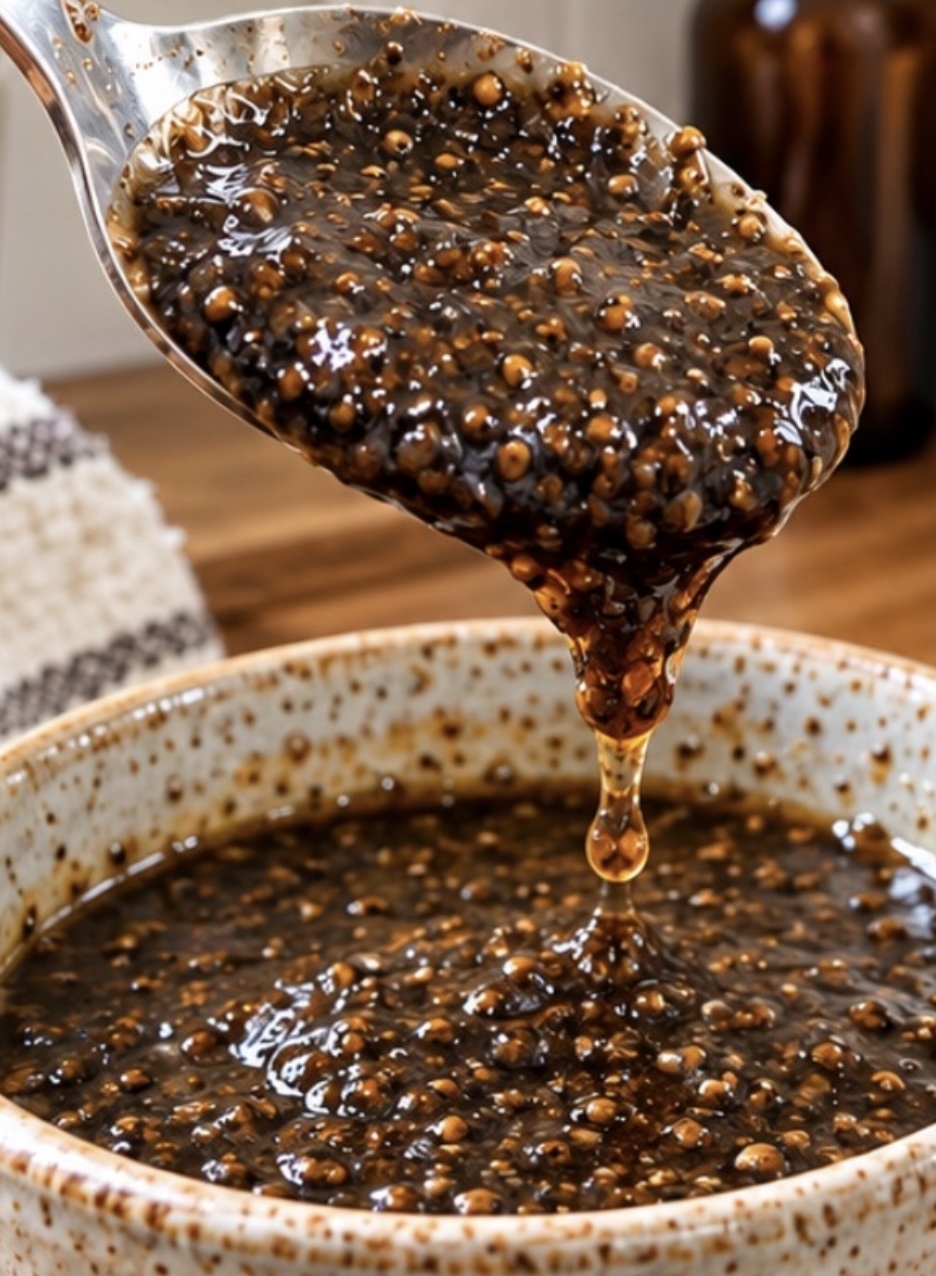
The image shows a rich, glossy homemade hair treatment made from dark seeds suspended in a thick gel. This recipe recreates that idea using flaxseeds and black seeds (Nigella sativa). The result is a naturally textured gel that can be used as a pre-shampoo treatment or a light hair mask.
This homemade treatment is designed to condition the hair, improve softness, reduce the feeling of dryness, and make hair easier to manage. It should not be presented as a guaranteed treatment for baldness, hair loss, gray hair, or thinning hair. Hair growth and hair loss have many possible causes, and a homemade mask cannot reliably reverse them.
Black Seed & Flaxseed Hair Gel Mask
What Makes This Recipe Special?
Flaxseeds are especially useful in DIY hair preparations because they release a slippery gel when simmered in water. That natural gel can coat the hair lightly, helping it feel smoother and more conditioned.
Black seeds are traditionally used in various beauty routines. When incorporated into a homemade treatment, they add plant-based ingredients and a distinctive appearance to the mixture.
Together, the ingredients create a simple hair mask that feels rich without requiring complicated equipment or expensive products.
Ingredients
For approximately 1 cup of hair gel:
- 3 tablespoons whole flaxseeds
- 1 tablespoon black seeds (Nigella sativa)
- 2 cups filtered or distilled water
- 1 teaspoon aloe vera gel, preferably pure and fragrance-free
- 1 teaspoon jojoba oil or sweet almond oil
- 3–5 drops lavender essential oil, optional
- 1 teaspoon vegetable glycerin, optional, for extra moisture
Equipment
You will also need:
- Small saucepan
- Wooden spoon
- Fine-mesh strainer
- Clean glass jar or container
- Small bowl
- Spoon
- Clean applicator bottle, optional
Step 1: Prepare the Seeds
Begin by measuring the flaxseeds and black seeds carefully.
Place both types of seeds into a small saucepan. Add the two cups of water and stir gently.
Allow the seeds to sit in the water for approximately five minutes before heating. This isn’t absolutely necessary, but it gives the seeds a little time to hydrate.
Flaxseeds will eventually release their natural mucilage into the water. This is what creates the characteristic slippery consistency of flaxseed gel.
The mixture may become darker because of the black seeds. Don’t worry if it doesn’t look exactly like commercial hair products. Homemade preparations naturally vary in color and thickness.
Step 2: Simmer the Mixture
Place the saucepan over medium heat.
Bring the mixture to a gentle simmer while stirring occasionally.
Once it begins simmering, reduce the heat slightly. Continue cooking for approximately 8–12 minutes.
You should notice the liquid becoming thicker.
To test the consistency, lift a small amount with your spoon. The mixture should become somewhat slippery and form a thin gel-like trail as it falls from the spoon.
Avoid boiling the mixture aggressively. A gentle simmer is easier to control and reduces the chance of the liquid foaming excessively or sticking to the bottom of the pan.
If the mixture becomes extremely thick before the cooking time is complete, add a little water.
Step 3: Check the Texture
The ideal consistency depends on how you want to use the treatment.
For a rinse-out mask, a relatively thick gel works well.
For a leave-in styling gel, you may prefer a thinner consistency.
Remember that the mixture will continue to thicken slightly as it cools.
A good texture should be:
- Smooth
- Slippery
- Gel-like
- Easy to spread
- Not excessively watery
- Not so thick that it is difficult to remove
If your mixture is too thin, simmer it for another minute or two.
If it is too thick, stir in a few tablespoons of warm water.
Step 4: Strain the Gel
This is one of the most important steps.
Place a fine-mesh strainer over a clean bowl.
Carefully pour the hot mixture through the strainer.
Use the back of a spoon to gently press the seeds and extract as much gel as possible.
Be careful because the mixture will be hot.
The finished gel should collect underneath while most of the seeds remain in the strainer.
If you want an especially smooth treatment, strain it a second time through a clean fine-mesh strainer.
For the appearance shown in the image, you can leave a very small amount of seed material in the mixture. However, removing most of the seeds makes the treatment much easier to apply and rinse from the hair.
Step 5: Add the Conditioning Ingredients
Allow the strained gel to cool until it is warm or completely cool.
Do not add essential oil or other heat-sensitive ingredients while the mixture is extremely hot.
Add:
- 1 teaspoon aloe vera gel
- 1 teaspoon jojoba or sweet almond oil
- Optional glycerin
- Optional lavender essential oil
Stir thoroughly.
The aloe vera adds a smooth, lightweight texture, while the small amount of oil can help give the treatment a more conditioning feel.
You don’t need a large amount of oil. Too much can make the hair greasy and may make the mask difficult to rinse.
How to Apply the Hair Mask
Before applying the mixture to your entire scalp or hair, perform a small patch test.
Once you’ve established that your skin tolerates the ingredients, divide your hair into sections.
Apply a small amount of the gel to the scalp and hair.
Massage gently with your fingertips for about 2–3 minutes. Avoid aggressive scratching or rubbing.
Then distribute the remaining product through the lengths and ends.
If your hair is particularly dry, concentrate more product on the mid-lengths and ends rather than applying a large quantity directly to the scalp.
You don’t need to saturate the hair completely.
A thin, even coating is generally enough.
How Long Should You Leave It On?
For a first application, leave the mask on for approximately 15–20 minutes.
You can cover the hair loosely with a shower cap if desired.
There is no need to leave the mask overnight.
Longer application does not automatically mean better results. In fact, keeping a homemade mixture on the scalp for many hours can increase the chance of irritation, especially if you have sensitive skin.
After 15–20 minutes, rinse thoroughly with lukewarm water.
Follow with your normal shampoo if necessary, especially if you added oil.
Finish with your regular conditioner.
How Often Can You Use It?
For most people, once a week is a reasonable starting point.
If your hair responds well and doesn’t become heavy or coated, you may continue with a weekly treatment.
People with fine or oily hair may prefer using it every 10–14 days.
People with very dry, coarse, or curly hair may find a weekly conditioning treatment more useful.
There is no need to use the mask every day.
Why Flaxseed Is Used in Hair Care
Flaxseeds contain compounds that become mucilaginous when exposed to water.
This creates the slippery gel that makes flaxseed popular in homemade hair-care recipes.
The gel can help:
- Improve the feel of dry hair
- Reduce friction during styling
- Make curls feel more defined
- Give hair a smoother appearance
- Provide lightweight conditioning
- Make detangling easier
The important distinction is that these are cosmetic effects. A hair mask can make existing hair look and feel better without necessarily changing the biological growth cycle of the hair follicle.
What About Black Seeds?
Black seeds, also known as Nigella sativa, have a long history of traditional use.
They contain naturally occurring plant compounds and oils, which is one reason they appear in traditional beauty preparations.
However, it is important not to turn traditional use into a medical promise.
There isn’t enough evidence to say that a homemade black-seed hair mask will reliably regrow thinning hair, reverse baldness, close a widening part, or restore naturally gray hair.
Think of black seed as an optional cosmetic ingredient rather than a guaranteed hair-growth treatment.
Can This Recipe Make Hair Grow Faster?
This is one of the biggest claims often made about homemade hair treatments.
A hair mask can make the hair appear healthier, smoother, shinier, or fuller, particularly when dryness and breakage are making the hair look thin.
But that is different from increasing the biological growth rate of hair.
Hair grows from follicles beneath the skin, and the growth cycle is influenced by genetics, hormones, age, nutrition, health, medications, and other factors.
Therefore, this recipe should be considered a conditioning and scalp-care treatment, not a proven hair-growth medication.
If you are experiencing sudden or significant hair loss, a widening part, bald patches, scalp inflammation, or persistent shedding, it is better to speak with a dermatologist or other qualified healthcare professional.
Can It Reverse Gray Hair?
No homemade mask should be advertised as a guaranteed way to turn gray hair permanently dark again.
Gray hair generally occurs when hair follicles produce less pigment.
Applying a dark-colored mixture to the hair can temporarily change its appearance through staining or residue, but this isn’t the same as restoring natural pigment production.
If the goal is simply to make gray or silver hair look glossy and well-conditioned, this type of mask may improve its cosmetic appearance.
Tips for Different Hair Types
For Dry Hair
Add the teaspoon of jojoba or almond oil.
You can also apply a little extra conditioner after rinsing.
Focus the treatment on the lengths and ends.
For Oily Hair
Use less oil or omit it completely.
Apply primarily to the lengths rather than heavily coating the scalp.
Rinse thoroughly.
For Curly Hair
Flaxseed gel can be particularly useful as a lightweight styling ingredient.
After washing, a small amount of the cooled gel can be scrunched into damp curls.
Start with a tiny amount because too much can leave a noticeable film.
For Fine Hair
Use a very small amount.
Heavy applications may make fine hair appear flat.
A thinner gel is usually easier to distribute.
Storage Instructions
Because this recipe contains water and fresh plant ingredients but no reliable preservative system, it is perishable.
Transfer the cooled mixture into a clean, airtight glass container.
Keep it refrigerated.
For safety and quality, it is best to make a small batch and use it within about 3–5 days rather than storing it for weeks.
If you notice:
- A sour smell
- Mold
- Bubbles that weren’t present originally
- Major color changes
- Unusual separation
- A slimy or spoiled appearance
discard the entire batch.
Do not try to rescue a spoiled homemade cosmetic by boiling it again.
For longer storage, commercial preservative systems and appropriate formulation practices are required.
Important Safety Tips
Natural does not automatically mean risk-free.
Before applying this mask to your scalp, test a small amount on an inconspicuous area of skin.
Wait to see whether irritation develops.
Do not use the treatment on:
- Broken skin
- Scratched skin
- Active scalp wounds
- Areas with severe irritation
- Recently burned skin
Avoid getting the mixture into your eyes.
If you experience burning, intense itching, swelling, rash, or other significant irritation, rinse immediately and discontinue use.
Essential oils are optional and can cause irritation in some people. If your scalp is sensitive, simply leave them out.
A Simpler Two-Ingredient Version
If you want the easiest possible version, you can make this recipe with only:
3 tablespoons flaxseeds + 2 cups water
Simmer until the mixture becomes gel-like, strain it, cool it, and apply it to the hair.
This version is particularly convenient because it avoids unnecessary ingredients.
You can add black seeds when you want the darker, more traditional-looking preparation shown in the image.
How to Use the Gel as a Styling Product
The cooled flaxseed gel can also be used in a completely different way.
After washing your hair, apply a pea-sized amount to damp hair.
For curly or wavy hair, gently scrunch the product into the lengths.
Allow the hair to air-dry or use your preferred drying method.
If the hair feels stiff once dry, gently squeeze the curls with clean hands.
Start with a very small amount.
You can always add more, but applying too much homemade gel at once can make the hair feel sticky or weighed down.
Final Thoughts
This Black Seed & Flaxseed Hair Gel Mask is a simple homemade recipe inspired by traditional plant-based hair care. Its biggest practical benefit is its conditioning, slippery texture, which can help hair feel softer, smoother, and easier to manage.
The recipe requires only a few inexpensive ingredients and can be prepared in under 20 minutes.
For the best experience, use it as part of a broader hair-care routine that includes gentle washing, regular conditioning, minimizing excessive heat, avoiding unnecessarily tight hairstyles, and protecting the hair from excessive mechanical damage.
Most importantly, keep expectations realistic. A homemade hair mask can be a pleasant addition to your beauty routine, but dramatic claims such as making hair look decades younger, permanently reversing gray hair, or guaranteeing new hair growth are not supported simply by preparing and applying a seed-based gel.
Used as a simple conditioning treatment, however, this glossy flaxseed-and-black-seed gel can be an enjoyable, inexpensive addition to your weekly self-care routine.