
It confirmed exactly what some part of me had already known since the day I met him.
⸻
I stopped reading for a moment there, my hands pressed flat against the table, twenty years of assumptions rearranging themselves all at once.
“Did you two know this?” I asked, looking up at my sisters. “This whole time?”
“Only since we were eighteen,” Nora said. “We read it together, once, the night it arrived. We never talked about it again after that, not really. We just agreed to hide it.”
I made myself keep reading.
⸻
I don’t have a good excuse for what I did with that information, Micah. I’ve spent twenty years trying to construct one, and none of them hold up under any real weight.
I was ashamed. Not of the girls — never of them, not for one single day — but of myself, and of what I’d have to face if the truth ever came out the way I was certain it eventually would. Your father’s friends. My own mother, still alive back then. The whole town, if I’m honest about how small that town really was.
I told myself the girls deserved a mother who wasn’t drowning in that kind of shame every time she looked at them. I told myself, somewhere in the middle of that terrible logic, that leaving was somehow the responsible thing to do, instead of admitting it was simply the easiest thing to do for me.
I want you to understand something clearly, because I think it’s the only part of this letter that actually matters. Those girls are not less yours because of anything in this letter. They never were. You raised them, Micah. Not me. Whatever blood says about who fathered them has nothing to do with who actually built a family out of the wreckage I left behind.
I hope, by the time you read this, you’ve already understood that on your own, without needing me to say it. I hope I’m not the one who finally taught you that lesson, twenty years too late to matter to anyone but myself.
I’m sorry. For all of it. For leaving, and for making you carry something that should have been mine to carry instead.
Mom
⸻
I set the letter down on the table and looked at my sisters — twenty years old now, all three of them watching me with the exact same expression, waiting to see whether the truth in that envelope had actually changed anything between us.
“You thought this would make me love you less,” I said slowly, working through it out loud. “That’s why you hid it for two years.”
“Wouldn’t you have wondered?” Wren asked, her voice cracking. “If you’d read that the day it arrived — wouldn’t some part of you have looked at us differently, even just a little?”
⸻
I thought about that question honestly before I answered it, because I owed them an honest answer, not just a comforting one.
“I don’t think so,” I finally said. “But I understand why you were scared enough not to take that chance.”
“We were eighteen,” Nora said. “We’d just found out our whole existence started because of something Mom was ashamed enough of to run from her own kids. We didn’t know how to hand that to you and still be sure you’d stay.”
“I’ve never once stayed because of biology,” I said. “I stayed because three babies were crying down that hallway, and nobody else was coming. That’s the whole reason. It was true the day I signed those adoption papers, and it’s still true right now, sitting at this table.”
⸻
Piper was crying harder now, the kind of crying that comes from relief as much as grief.
“So it doesn’t change anything,” she said. “For real.”
“It changes what I understand about why Mom left,” I said. “It doesn’t change one single thing about what the four of us built after she did.”
I reached across the table and took all three of their hands at once, the way I used to when they were small enough that one of my hands could nearly wrap around all three of theirs.
“You are my sisters,” I said. “You are also my daughters, in every way that word has ever actually meant something. Both of those things have been true for twenty years, and a letter written by a woman who couldn’t handle her own guilt doesn’t get to unmake either one.”
⸻
We took our photo late that night, long after the cake had gone half-eaten and the letter had been folded carefully back into its envelope and set on the counter instead of hidden away again.
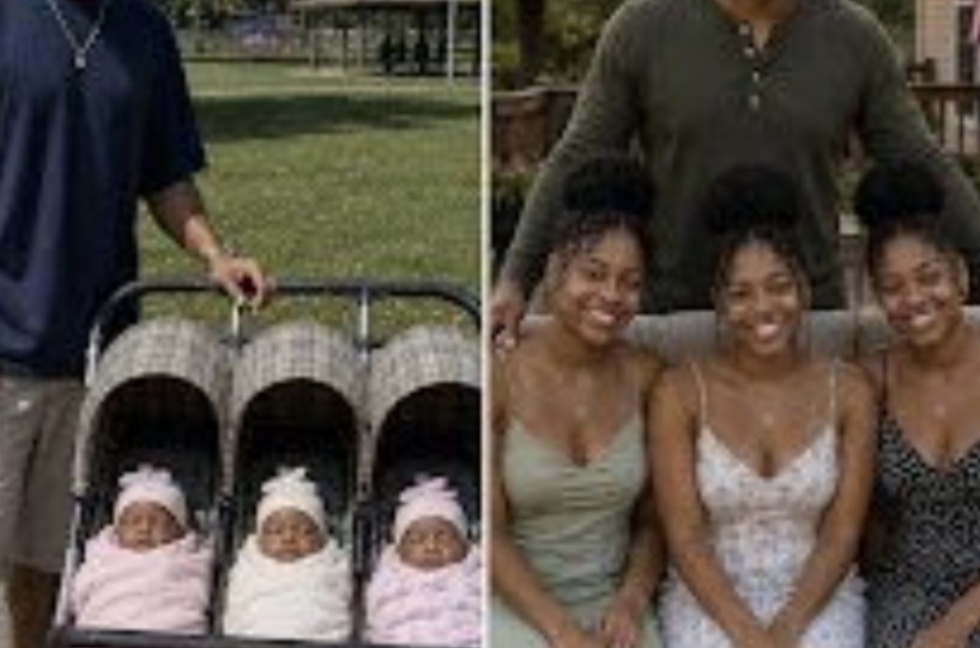
It’s the twenty-first photo in that hallway now — four faces a little older, a little more tired, but standing exactly where we always stand, against the same wall we’ve stood against every year since three babies were too small to hold their own heads up.
I don’t know if I’ll ever fully make peace with everything in that letter. Some nights, I still think about a woman standing in a doorway, looking like she wanted to say one more thing before she left, and I wonder if that unsaid sentence was some earlier, smaller version of the confession that finally reached me twenty years later.