
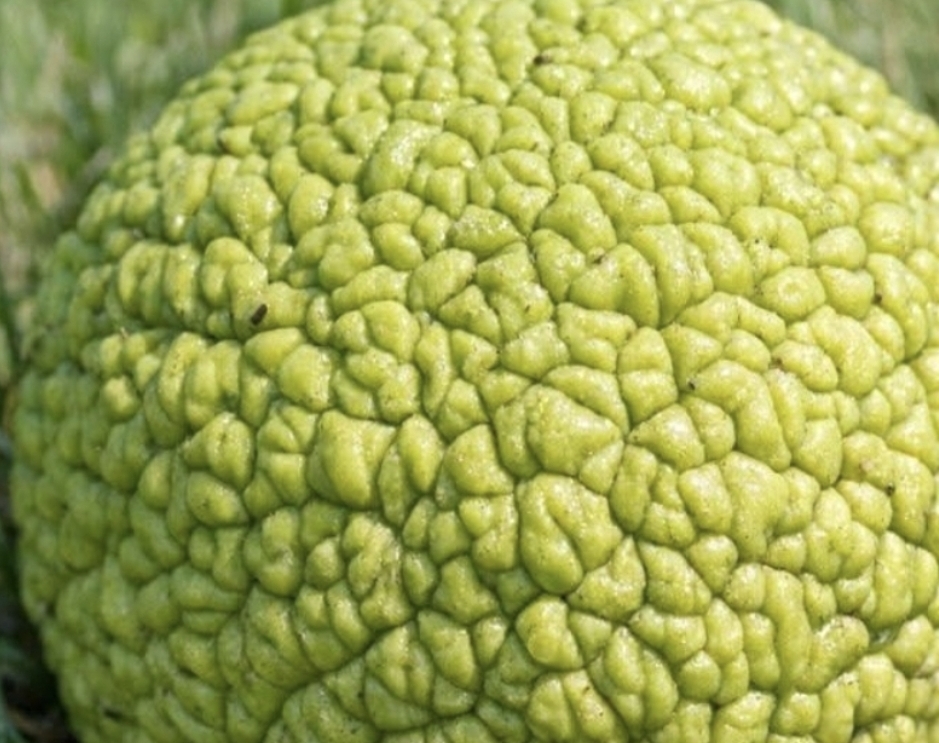
Imagine taking a leisurely walk through a wooded area when you suddenly come across a peculiar sight—a green, bumpy sphere lying on the ground, seemingly out of place. Its surface is uneven and almost brain-like, exuding a sticky substance that clings to your fingers. Curiosity piqued, you wonder what this odd discovery could be.
This mysterious object is not a product of science fiction but a natural wonder known as the Osage orange. Its unusual appearance and intriguing texture have led many to question its origin and purpose. In this article, we delve into the fascinating world of the Osage orange, exploring its characteristics, uses, and the myths surrounding it.
- Meet the Osage Orange: The ‘Brainy’ Green Fruit
The Osage orange, scientifically known as Maclura pomifera, is a unique fruit native to North America. Its most striking feature is its deeply wrinkled, bumpy surface that resembles the convolutions of a human brain. These fruits can grow to impressive sizes, typically measuring between 8 to 15 centimeters in diameter and weighing up to 1 kilogram.
Contrary to its name, the Osage orange is not related to the common orange. Instead, it belongs to the Moraceae family, making it a cousin of the mulberry and fig. The name ‘Osage’ derives from the Osage Nation, a Native American tribe indigenous to the region where the tree naturally grows. The fruit’s green hue and distinctive texture make it an unmistakable sight in the autumnal landscape. - How To Identify Osage Orange at a Glance
Identifying an Osage orange is relatively straightforward once you know what to look for. The fruit is large, round, and covered with a network of ridges and grooves, giving it a brain-like appearance. Its color ranges from vivid green to a yellowish hue as it matures.
The tree itself can grow between 8 to 15 meters tall, with a dense, thorny thicket of branches. Its leaves are simple, ovate, and glossy, turning a bright yellow in the fall. The wood of the Osage orange tree is notably dense and strong, often used historically for tool making and other practical purposes. - Why Is It So Bumpy, Sticky, and Weirdly Textured?
The Osage orange’s bumpy texture is due to its unique growth pattern. As the fruit develops, the internal tissues expand at different rates, resulting in the characteristic convolutions. This irregular surface is not only visually striking but also serves to protect the seeds contained within the fruit’s core.
Touching an Osage orange reveals a sticky, milky sap that oozes from the fruit. This latex-like substance is a natural defense mechanism against pests and diseases. However, while the sap is harmless to humans, it can be a sticky nuisance if it gets on clothing or skin. - Is This Strange Green Ball Safe To Touch or Smell?
While the Osage orange may appear intimidating due to its size and unusual texture, it is generally safe to touch and smell. The sticky sap, although messy, is not toxic. Some people even find the fruit’s faint citrus-like scent pleasant.
However, it’s advisable to wash your hands after handling the fruit, as the sap can cause mild skin irritation in sensitive individuals. As with any wild plant, it’s best to exercise caution and avoid placing the fruit near your face or eyes. - Can You Eat Osage Oranges—or Are They Poisonous?
Despite resembling some edible fruits, Osage oranges are not considered palatable for humans. The fruit is extremely hard and fibrous, with a bitter taste that discourages consumption.
While not toxic, the fruit’s texture and taste make it unsuitable for eating. Ingesting large quantities of the seeds or sap is not recommended, as they can cause stomach discomfort. Historically, there are no records of Osage oranges being used as a food source for humans. - What Wildlife Actually Does With Osage Orange Fruits
While humans may not find Osage oranges appetizing, certain wildlife species make use of these fruits. Squirrels and other rodents have been known to gnaw through the tough exterior to access the seeds inside, which are a rich source of nutrients.
Interestingly, the Osage orange fruit was likely consumed by large megafauna such as mammoths and giant sloths in prehistoric times. These animals would have been capable of breaking open the hard fruits and dispersing the seeds across the landscape, aiding in the tree’s propagation. - The Tree Behind the Fruit: Where Osage Orange Grows
The Osage orange tree is native to the south-central United States, particularly in regions of Texas, Oklahoma, and Arkansas. It thrives in a variety of soil types and is remarkably adaptable, often found in fields, pastures, and along fence lines.
Due to its hardy nature, the tree has been widely planted outside its native range and can now be found across the eastern and central United States. The tree’s resilience, combined with its dense, thorny branches, has made it a popular choice for creating natural hedges and windbreaks. - Old-School Uses: Living Fences, Wood, and Folk Remedies
Historically, the Osage orange tree was highly valued for its wood, which is exceptionally strong and rot-resistant. Native American tribes, such as the Osage, utilized the wood to craft bows and other tools, thanks to its flexibility and durability.
In the 19th century, the tree was widely planted as a ‘living fence’ before the invention of barbed wire. The dense, thorny branches formed an effective barrier to livestock. Additionally, various folk remedies have been derived from the tree’s sap and wood, though these uses are largely anecdotal and not scientifically validated. - Do Osage Oranges Really Repel Spiders and Pests?
A common myth surrounding Osage oranges is their supposed ability to repel spiders and other pests. Many people place the fruits around their homes as a natural insect deterrent.
However, scientific evidence supporting these claims is limited. While the fruit contains compounds that can be mildly repellant, their effectiveness is not well-documented. Most experts agree that any pest-repelling properties are likely minimal. - Lookalikes: Other Fruits That Might Confuse You
While the Osage orange is distinctive, it can sometimes be confused with other fruits or nuts. One potential lookalike is the black walnut, which also has a rough, green exterior, but is generally smaller and releases a strong, pungent odor when opened.
Another possible source of confusion is the horse apple, a colloquial name sometimes erroneously applied to Osage oranges. However, true horse apples come from a different species altogether. When in doubt, observing the tree and its leaves can help confirm the identity of the fruit. - What To Do If You Find One in Your Yard or on a Walk
If you encounter an Osage orange in your yard or on a walk, consider leaving it in place to provide food for local wildlife. Alternatively, you can collect the fruits and use them as natural decorations, particularly in autumn displays.
For those interested in gardening, planting Osage orange seeds can result in a hardy, drought-resistant tree. However, be mindful of the tree’s size and thorny branches when selecting a planting location. Ultimately, the Osage orange is a fascinating piece of natural history worth appreciating, whether in the wild or as part of your landscape.